I can't believe it's been a whole week since I posted anything here. It has been busy, tiring, and, at times, enjoyable.
I'm currently preoccupied with finishing my C&G course work. The Texture book has been completed; I'm doing the final bits of stitching for Line, and I need to take some photos for my A3 pieces.
Although I have enjoyed my art evening class I won't do another one next year. It's just too tiring, especially as I've enrolled for my level 2 C&G in Creative Textiles. I've also been elected onto the local MS Society branch committee, and been asked to do the newsletter, so I'll have more than enough to keep me busy.
I finally made it to an Embroiderer's Guild meeting in Alnwick on Saturday afternoon. There was a fascinating speaker called Joanna O'Neill. She's a really multi-talented woman. You can see for yourself on her website: www.richstitch.com. Pop along and have a look.

Sunday, 8 June 2014

Sunday, 1 June 2014
Complex Cloth
I bought a used copy of "Complex Cloth A Comprehensive Guide to Surface Design" by Jane Dunnewold on Amazon Marketplace, and it was delivered yesterday. So far, due to doing other things yesterday, I've only managed to read the introduction, but what an introduction - I quote: "How can we make the cloth sing?" This question deeply resonated with me, as did Jane's assertion: "It is possible to create fabric of great depth and complexity - what I call 'complex cloth' - simply by beginning with white fabric and layering surface-design processes like dyeing, painting, bleaching, and foiling over one another until a pleasing result is achieved." If you've read my earlier blog posts you will know that I love dyeing and block printing fabric. Now I have a guide to these techniques, and more. This book was written in 1996, and there have been further developments in textile art materials, but it should give me a good jumping off point. Many of her techniques are used by fibre artists like Angie Hughes, so by combining the things I learn in college with this book and my Colouricious DVDs, I have lots of scope for experimenting to create my own complex cloth.
Tuesday, 27 May 2014
Step by Step Ice Dyeing
Ice dyeing is straightforward, and gives amazing results. If, like me, you love the surprises that random dyeing techniques give then ice dyeing is for you.
The first step is to wash your fabric to remove any starch or manufacturer's dressing. Then you need to soak your fabric in a soda ash solution. This will ensure the dye is fixed, and makes the fabric washable. You need one cup of soda ash per gallon of water - I got the directions from an American website, but you can use google to find UK or European equivalent measurements.
While the fabric is soaking you can set up your dyeing station. You need a rack that you can arrange the fabric on and cover with ice cubes; and under the rack you need something that the melted ice & dye mixture can drain into. I found plastic garden riddles in a local branch of Yorkshire Trading. Some people use the cooling racks that you put cakes on. I placed my riddle over a washing up bowl. You can place fabric in the bottom of the tub that will catch the melted ice water, and get great effects.


Decide what colours you want to use, bearing colour theory in mind as the dyes will blend as the ice melts. For this project I used peach, magenta, and yellow Procion mx dye.


The fabric in the riddle before being rinsed out and washed.



The first step is to wash your fabric to remove any starch or manufacturer's dressing. Then you need to soak your fabric in a soda ash solution. This will ensure the dye is fixed, and makes the fabric washable. You need one cup of soda ash per gallon of water - I got the directions from an American website, but you can use google to find UK or European equivalent measurements.
While the fabric is soaking you can set up your dyeing station. You need a rack that you can arrange the fabric on and cover with ice cubes; and under the rack you need something that the melted ice & dye mixture can drain into. I found plastic garden riddles in a local branch of Yorkshire Trading. Some people use the cooling racks that you put cakes on. I placed my riddle over a washing up bowl. You can place fabric in the bottom of the tub that will catch the melted ice water, and get great effects.
Fabric to be dyed in the plastic riddle
Fabric covered with ice cubes.
When the fabric has been soaking for 30 minutes remove it from the soda ash solution, wring it out and place it on your chosen rack. Crumpling the fabric helps create the pattern. Then completely cover the fabric with ice cubes. For this project I used a 2Kg bag of ice. I had two long strips of 10" wide dry cotton in the basin, which had previously been treated with soda ash.
When the fabric has been soaking for 30 minutes remove it from the soda ash solution, wring it out and place it on your chosen rack. Crumpling the fabric helps create the pattern. Then completely cover the fabric with ice cubes. For this project I used a 2Kg bag of ice. I had two long strips of 10" wide dry cotton in the basin, which had previously been treated with soda ash.
Decide what colours you want to use, bearing colour theory in mind as the dyes will blend as the ice melts. For this project I used peach, magenta, and yellow Procion mx dye.
Sprinkle your chosen Procion dye randomly over the ice cubes. Wear a dust mask to avoid breathing in any dye powder as it is a hazardous substance. When you have sprinkled the dye powder on the ice, cover the whole thing with plastic. Leave for 24 hours, allowing all of the ice to melt. Once all the ice has melted you can rinse out the dye and wash the fabric as normal.
The fabric in the basin before being rinsed out and washed.
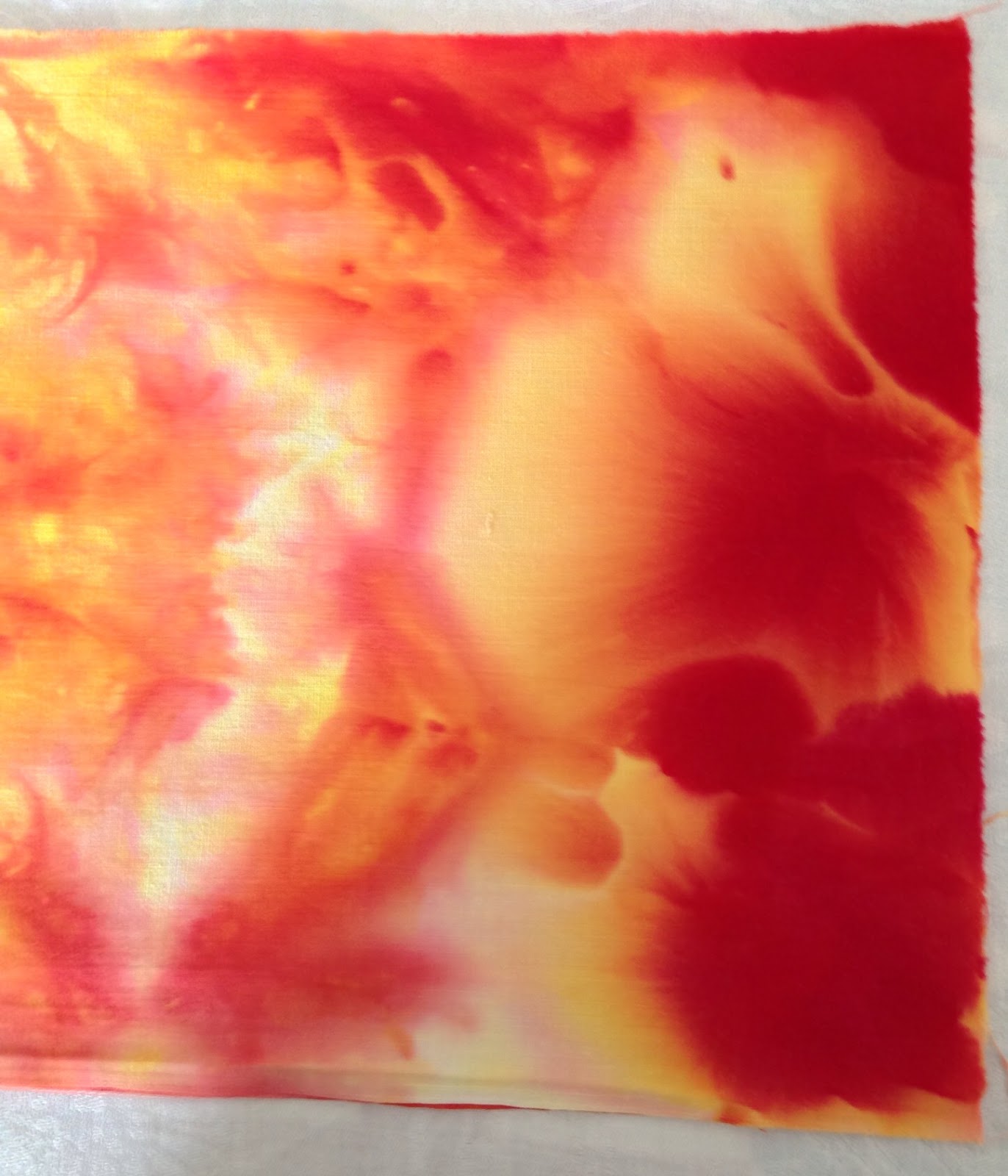
And some of the results:
Thursday, 22 May 2014
The wonderful work of Jenny Adin-Christie
On Saturday 17th June I was Lucy enough to have been invited by 3 of the members to the Embroiderer's Guild regional meeting. The highlight of the day for me was the talk by Jenny Adin-Christie. This is a brief summary of Jenny's talk. If the opportunity presents itself go and hear her in person.
Jenny is a Graduate Apprentice of the Royal School of Needlework, and she began her talk by giving us some history of the RSN. I was fascinated to learn that it had been set up by Lady Victoria Welby to create respectable employment for genteel women. The School started with 20 young girls who, after training, worked a 50 hour week. They produced amazing hand embroidered furnishings. The School was criticised for its eclecticism and lack of house style so designers, including Gertrude Jekyll, William Morris and Edward Burne-Jones, were commissioned.
The School was responsible for embroidering the Coronation trains for Queen Elizabeth, the Queen Mother, and also for the Queen. The Queen's train was made from specially woven silk velvet and took 10 women 2 and a half months to complete. The Queen is the current patron of the School.
When Jenny was an apprentice at the School she was trained in gold work to coronation standard, as well as learning crewel work, two kinds of silk shading and white work. The school teaches "both sides alike" embroidery, which was developed for regimental banners. At the time when she was training the School employed their students when their apprenticeship was completed, and Jenny worked for them spending 50% of her time teaching and 50% of her time stitching. Projects she worked on include stitching the tiny coat of arms on gloves for The Lord Chief Justice and, at the other end of the scale, the Royal Opera House Curtains. Other work by Jenny includes white work monogramming for Paul McCartney and alter frontals for Canterbury Cathedral.


Perhaps the most widely recognised piece of work Jenny has been involved with very recently is Kate Middleton's wedding dress. She was one of 70 women involved in stitching the lace motifs onto panels to create the dress. She also stitched the monogram on the cashmere baby gifts from Sarah Burton to Prince George.
Jenny is now a freelance specialist embroiderer and tutor. She undertakes bespoke commissions, designs, teaches groups and individuals, gives talks and lectures, and has a range of kits for sale on her website. If you ever get an opportunity to hear Jenny speak, or attend one of her classes, then grab it with both hands! The whole audience was captivated by her presentation. It is now my ambition to participate in one of her workshops - preferably in sunny France.
Wednesday, 21 May 2014
Block printing
I'm in love with block printing! Yes, I'm a fickle crafter - there are just too many things I love. As I mentioned in a previous post, I've invested in some wood blocks and workshop DVDs from Colouricious. I watched the DVD on printing with the wooden blocks before attempting it, and I'm glad I did. The DVD is full of tips on how to get the best patterns. The sun is shining in Morpeth today, so I'm hoping to get some photographs taken.
I also want to try ice dyeing today, if I can get myself organised enough.
More good news - I've heard back from Jenny Adin-Christie, so I'll be blogging about the talk she gave at the weekend very soon. Watch this space.
I also want to try ice dyeing today, if I can get myself organised enough.
More good news - I've heard back from Jenny Adin-Christie, so I'll be blogging about the talk she gave at the weekend very soon. Watch this space.
Sunday, 18 May 2014
This week's exciting things
There has been quite a lot happening this week, and so today is very much a day of rest. I'm writing this while sitting up in bed drinking coffee, and forcing myself not to get up and play with all the lovely things I'm going to tell you about.
I think I mentioned wooden printing blocks in a previous post. Well, the wonderful Colouricious website (http://colouricious.com) has fabulous things for textile artists and crafters. I got their email newsletter last week which gave details of a special offer this month - all their DVD workshops half price. I knew that tucked away in my emails was one from them when I signed up for the Colouricious Club (which is free) giving me 20% off my first order. This meant I could buy the DVDs for half price and get a further 20% off too. Needless to say it was a done deal; and since I was getting the 20% off it made sense to buy the wooden printing blocks I wanted at the same time. They were all delivered yesterday! Now you'll understand why I want to dash out to the studio shed and play.
At my art class on Tuesday evening I got to use the tutor's top quality Unison chalk pastels. This experiences reinforced the lesson learned that, with art materials, you get what you pay for. Even my limited talents can produce a better result with the right materials. These pastels are handmade in Tarset, Northumberland. The colours are wonderful, and the texture is creamy. If pastels are your medium of choice I definitely recommend you try these.
On Thursday at college I had the space to lay out all of the work I've done for the Line module to see where there are gaps to be filled, as well as checking on anything else that is needed for texture. I've almost completed the work needed for both. I'm both delighted to have almost finished, and sad that I won't have any more classes for months. I do have the level 2 course starting in September to look forward to.
Last but not least I went to the Embroiderer's Guild Regional Day yesterday. I met a lovely group of ladies and attended the talks by two professional Embroiderer's. The first speaker was Jenny Adin-Christie, who trained at the Royal School of Needlework. She was one of the 70 needle-women who worked on Kate Middleton's wedding dress. I've emailed Jenny to ask if I can put some photographs of her work here as I'm planning a blog post on her talk. The other speaker was Jane Smith of Japanese Embroidery UK. Her work is beautiful too, but I'm afraid I was so enchanted by Jenny that Jane's talk suffered by coming after lunch. Japanese embroidery is very traditional and has a set style. It looks stunning, but the materials are expensive and the time it takes to learn it properly was off-putting to most people. Do take a look at Jane's websites: www.nejiribana.co.uk and www.japaneseembroideryuk.com as you might want to try it.
Saturday, 17 May 2014
Serendipity Dye Results
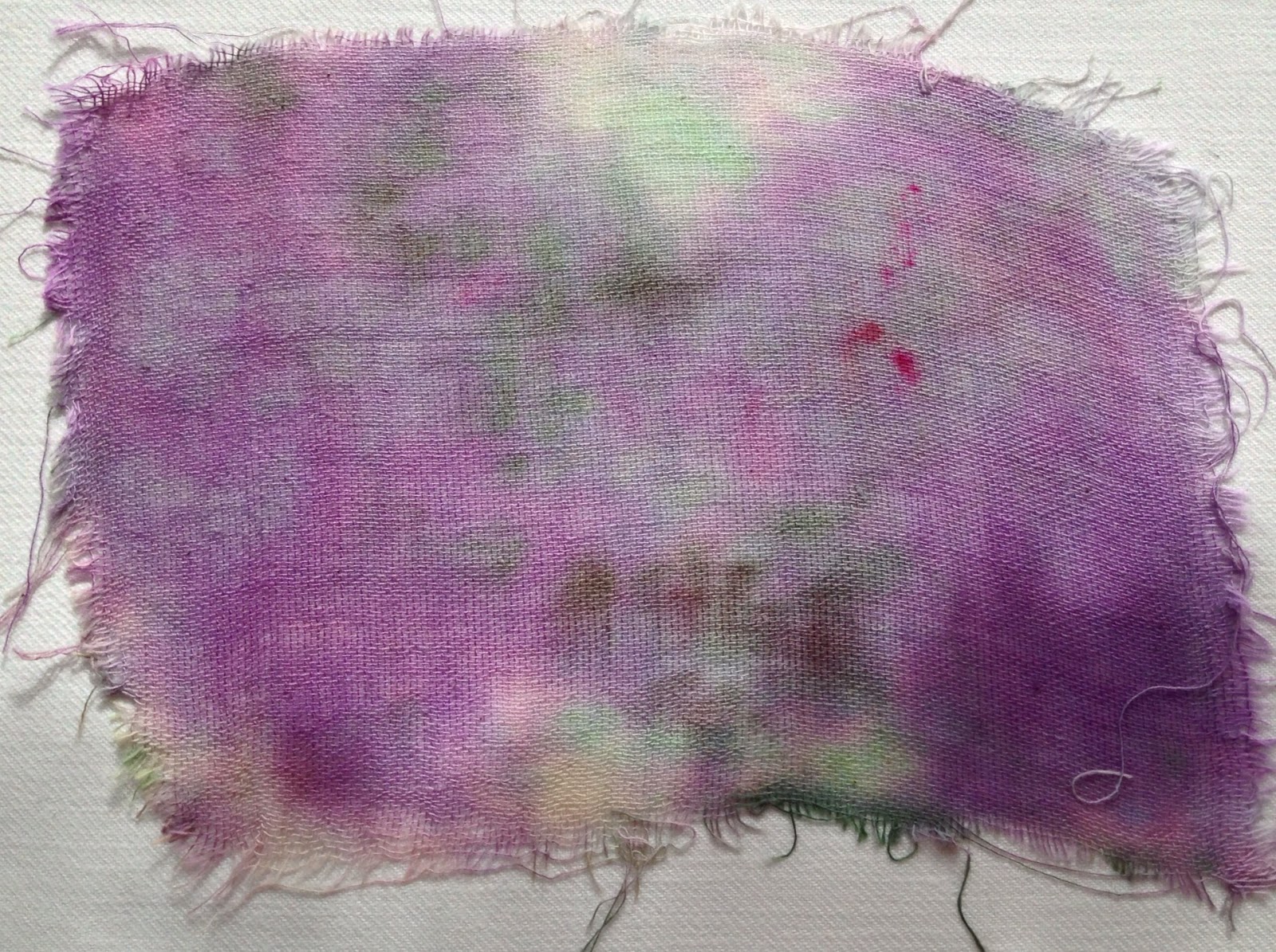
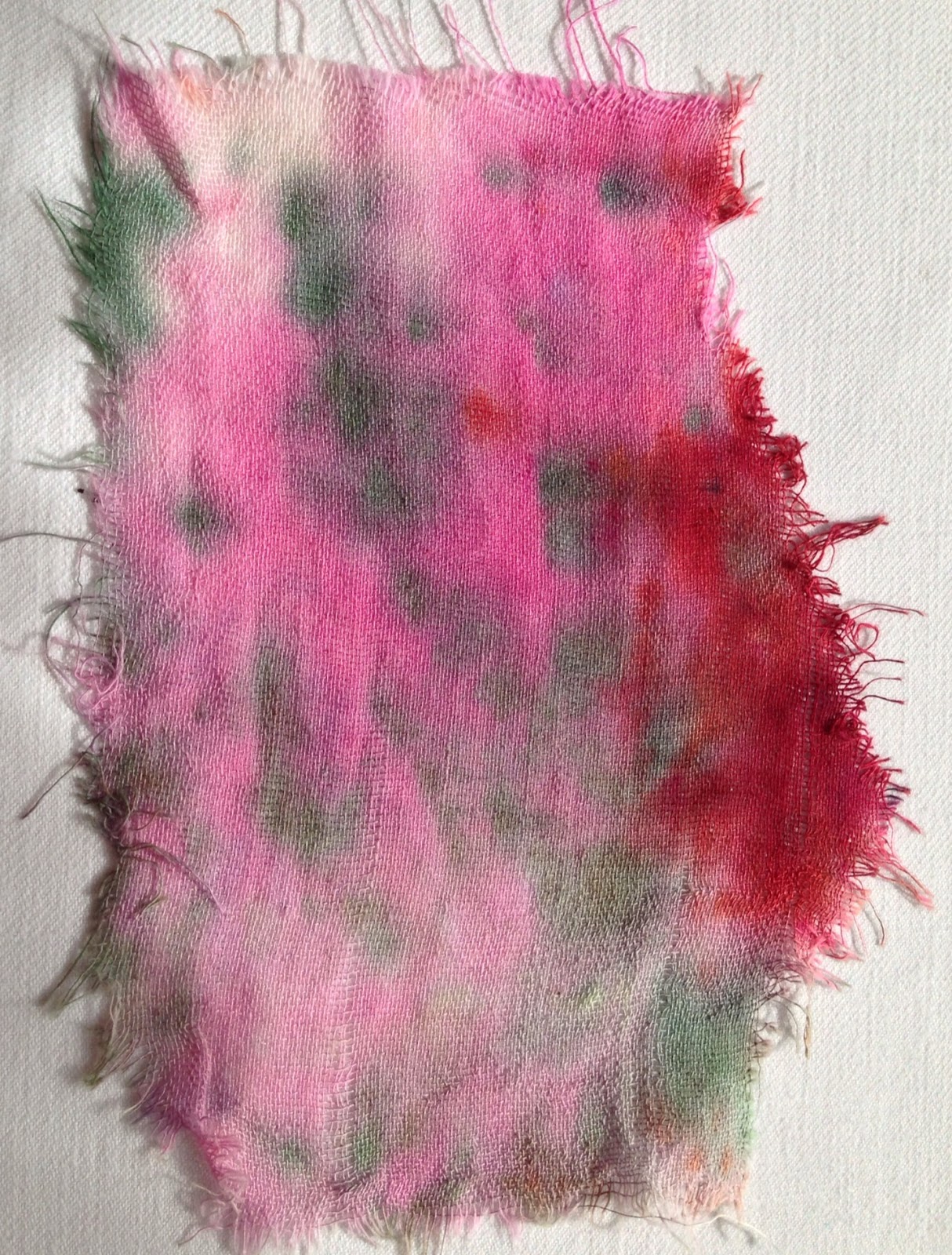
When I was doing the large batches of dyeing with the Dylon hand dye I found that some dye powder didn't dissolve. I filtered the dye through small fragments of unbleached muslin. These are the results -


Subscribe to:
Posts (Atom)